
Our Solution: LumosAI + IXgraph
LumosAI unifies enterprise silos – the missing architecture for AI

The IX Graph Data Model
At the heart of our platform lies the IX Graph Data Model — a unified, intelligent framework that connects every element of an organisation’s ecosystem into a single, coherent structure. IX (Integrated Experience) transforms fragmented data from people, processes, customers, and systems into a dynamic network of relationships, revealing how every part of the enterprise influences performance and experience.

Unlike traditional databases that store information in isolated tables, the IX graph creates a living map of organizational intelligence. Each node represents a concept — such as a decision, customer interaction, project, or financial outcome — and each relationship captures how these elements interact over time. This graph structure allows patterns, dependencies, and opportunities to emerge that would otherwise remain hidden

Ontology: The Intelligence Layer
Driving the graph is the IX Ontology — a semantic layer that gives meaning to data. The ontology defines how concepts relate to one another across business domains, ensuring that data from different sources speaks a common language.
By embedding ontological logic into the graph, IX can:
- Automatically interpret and classify data from any system or source.
- Identify causal connections between human, operational, and financial factors.
- Enable AI-driven reasoning, allowing the platform to simulate scenarios, predict outcomes, and recommend actions with contextual awareness.
In essence, the ontology is the brain, and the graph is the nervous system — together forming a self-organizing model of the enterprise that continuously learns and evolves.

From Data to Insight
The IX architecture turns raw data into actionable insight by linking context, meaning, and behavior. It allows leaders to:
- See how decisions ripple across teams, customers, and finances.
- Uncover the root causes behind performance shifts.
- Model future states and optimize actions in real time.
The result is a single, connected intelligence layer that enables organizations to operate with clarity, foresight, and precision.
The model
The IX (Integrated Experience) Model has been purpose-built to unify the way organizations understand and use their data. It was developed by creating shareable graph-based models derived from real-world profiles, engagement applications, financial systems, and customer feedback platforms — all integrated around a core employee and organizational model.
This architecture brings together the human, operational, and financial dimensions of the enterprise into a single, connected structure. Each element — people, processes, customers, and outcomes — becomes a node within the IX Graph, linked through relationships that reflect real-world interdependencies.
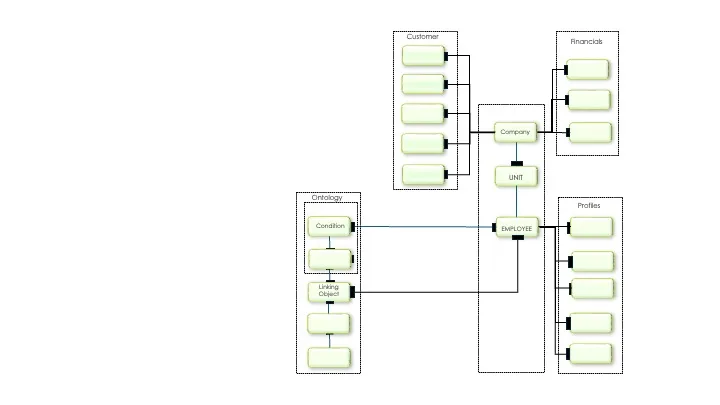
Ontology Integration
At the intelligence layer, the IX model connects directly to the IX Ontology, which provides the conditional definitions that govern meaning, context, and logic within the graph.
The ontology ensures that data from different systems, departments, or even organizations can be interpreted consistently. It defines not just what things are, but how they relate — allowing IX to automatically align information across domains such as performance, finance, customer experience, and engagement.
This interaction between the graph model and the ontology enables IX to reason about enterprise data in a human-like way:
- Ensuring semantic consistency across systems and scenarios.
- Mapping relationships dynamically as conditions change.
- Providing context-aware insights and predictions.

Standardized and Tested Across Enterprises
The IX Model has been validated using Python-based extractions from standard enterprise export files, ensuring that it remains consistent, interoperable, and scalable across industries.
This testing confirms that IX can integrate seamlessly with common data structures and workflows — offering a universal model that is both adaptable and standardised.

A Universal Model for Connected Intelligence
LumosAI grounds enterprise data in a shareable, semantically consistent graph—turning disconnected systems into a single, intelligent model that reveals how every factor influences every outcome.
Instead of just reporting what has happened, it allows organizations to ask the questions no typical analytical system can, including black swan questions that don’t rely on historical patterns or predefined metrics:
- Which unseen weak points could trigger a system-wide failure if stressed once?
- How would a shift in strategy silently propagate through culture, process, and customer experience before any KPI moves?
- Where are the domains that have never failed—but would have the highest impact if they did?
- What hidden interactions only become risky when previously unrelated factors intersect?
- If an unprecedented event hits a non-core process, what are the fastest paths to financial and reputational impact?
The result is a common intelligence framework that evolves with the enterprise—delivering clarity, coherence, and continuous learning across every level of operation, even when the future doesn’t look like the past.
Request a short executive briefing
"*" indicates required fields
Pilot FAQs
1. What is the LumosAI Pilot Programme?
The Pilot Programme offers a limited-invitation chance to utilise LumosAI’s analytics and AI-driven platform prior to its full commercial launch. Participants in the pilot will gain early access, help shape features, provide feedback, and influence our development roadmap.
2. Who can join?
We welcome organisations such as mid-to-large enterprises, business units, consulting firms or forward-thinking divisions that:
- Believe they are ready to engage with an early-stage AI/analytics service? Have clear business questions or data sources they want to address with LumosAI.
- Can commit the time and resources to giving us feedback during the pilot.
3. What are the benefits of participating?
- Early access to LumosAI’s core capabilities and modules before general release.
- A chance to influence feature-set, integrations, and product roadmap;
- Preferential commercial terms when the product launches;
- Close support from the LumosAI team during the pilot period..
4. Are there any costs or commitments?
- Usually the pilot is free of licence fees during the pilot period (subject to final terms);
- Participants must commit to providing feedback (e.g., via surveys, regular check-ins) and to using the system in a live environment;
- At the end of the pilot, participants may have first option to move into a paid contract.
5. What is the duration of the pilot?
The pilot will typically run for between 4-6 weeks (or specify your timeframe). At the end of the pilot we’ll conduct a review and decide next-steps together.
6. What data or technical requirements are there?
- You may need to connect data sources (for example, a financial application, Profiles/Engagement, or Customer export files) as agreed in the pilot scope.
- We’ll provide instructions and support for setup & onboarding.
- Data security, privacy and governance will be handled to enterprise standards. (You’ll receive our security-governance document.)
7. What support will be provided during the pilot?
- Onboarding session with the LumosAI team;
- Regular check-ins (e.g., bi-weekly) to review usage, feedback, and any issues;
- Access to help desk or technical support as needed;
- A dedicated success manager to guide you through the pilot.
8. What happens at the end of the pilot?
- We’ll schedule a review meeting to assess pilot results, usage, feedback and next steps;
- You’ll have the option to transition to a commercial licence (often with early-adopter benefits or favourable pricing);
- Based on feedback, we’ll adjust product scope, roadmap and integrations for general release.
9. How many participants are there in the pilot?
We are limiting the number of pilot participants to ensure high-quality support and close collaboration. At the moment, the initial cohort will be 6 organisations.
10. How do I apply?
- Complete the online Pilot Programme sign-up form;
- Provide a brief description of your organisation, and in the notes section your business challenges, data readiness and goals for the pilot; (although that can be left blank and we will discuss these in an initial meeting)
- Our team will review your submission, confirm eligibility and schedule an onboarding call.
11. Is there any risk or hidden clause I should know about?
- The pilot is provided “as is” and is subject to change since it’s an early programme;
- While we commit to data security and confidentiality, participants should recognise that features may evolve;
- Use of data will be governed by a pilot agreement (non-disclosure / data usage terms) to ensure protection of both parties.
12. What if I want to withdraw from the pilot early?
You may exit the pilot at any time (subject to the pilot agreement). We ask that you provide a short notice and, where possible, help us capture learnings on what led to the decision.
13. Will my data and insights generated during the pilot become yours?
- Your organisation retains ownership of your raw data;
- Any custom insights, dashboards or results produced by LumosAI for you will be accessible by you;
- For our own internal product development purposes, we may anonymise and aggregate learnings (with no attribution) under the pilot agreement.
14. What level of customisation is possible?
- We’ll work together to define the pilot’s scope (data sources, core use-cases, dashboards). While the pilot is standardised, we are open to certain integrations or tweaks to meet your business challenge (subject to resources).
15. Who should I contact for questions?
Please email us at pilot@lumosai.com (or your designated contact) or call 07740 182442. We’ll respond within one business day